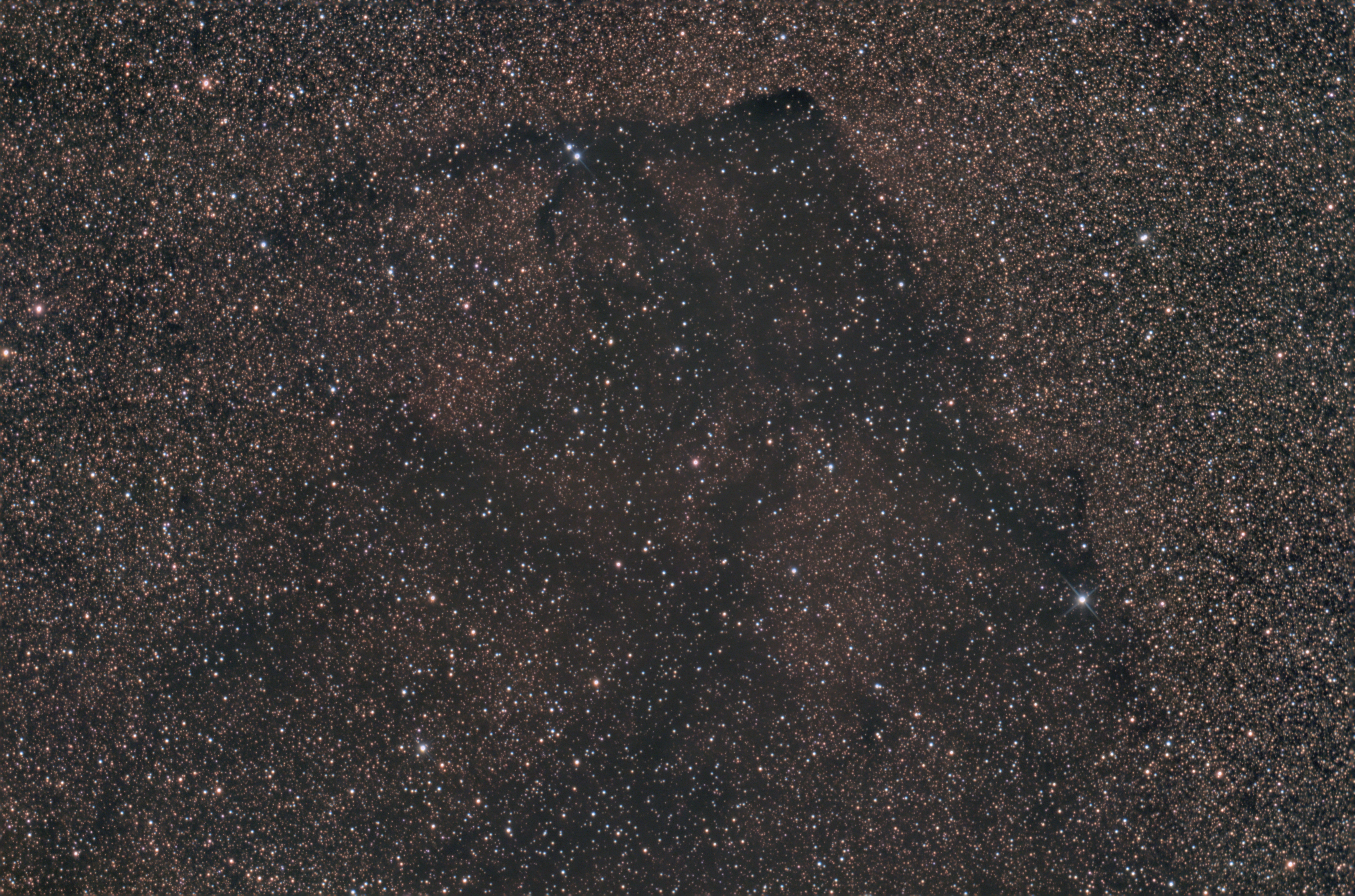
Not every deep sky target glows with the light of glowing gas or the combined brilliance of a billion suns. Some of the most striking objects in the night sky are defined by what is missing: Barnard 312 is a dark nebula, a dense cloud of interstellar dust so thick that it blocks the light of the stars behind it, appearing as a stark silhouette against the rich star fields of the Milky Way.
Barnard 312 sits in the constellation Scutum, roughly 2,000 light-years away, in the same neighborhood as two of my earlier targets: the Eagle Nebula (M16) and the Omega Nebula (M17). Its distinctive mushroom or comma shape makes it one of the most recognizable dark nebulae in the summer Milky Way. Photographically it is a challenge with a satisfying payoff: you are not capturing light emitted by the object itself, but recording the absence of light, and the quality of your result depends entirely on how deep and how clean your star field is. Any gradient, noise, or processing artifact will show up immediately against that inky black silhouette.
The Observation Details
- Integration: 46 x 180-second exposures (just under 2.3 hours)
- Capture: N.I.N.A 3
- Processing: Stacked and processed in Siril 1.4
- Telescope: Orion 8" 1000mm f/4.9 Newtonian reflector
- Mount: Orion Atlas EQ-G
- Imaging Camera: Canon T3i, full spectrum modified, at prime focus
- Guide Scope: Meade 800mm f/10 reduced to f/5 with Atik 0.5x focal reducer
- Guide Camera: Meade DSI Pro monochrome
No filters were used for this one. From a dark site, unfiltered luminance is the classic approach for dark nebulae: what you need most is total integration time and careful control of light pollution gradients during processing. Background extraction in Siril did the heavy lifting here, and I kept stretching gentle so the star field stays natural while the dust cloud keeps its dense, defined edge.
One of the things I enjoy most about dark nebula targets is how they invert your usual instincts. With an emission nebula you chase signal; here you chase the quality of the background. The star field is the subject as much as the cloud is, and every star counts. If you have been wanting to try something different after the usual bright nebulae and galaxies, pick a dark nebula near the Milky Way core and see how clean you can get your field.
You can see the full resolution image in the gallery, and if dark nebulae appeal to you, check out my earlier post on imaging dark nebula LDN 1719 for more on the technique.