
Click the image to view it full size in the gallery.
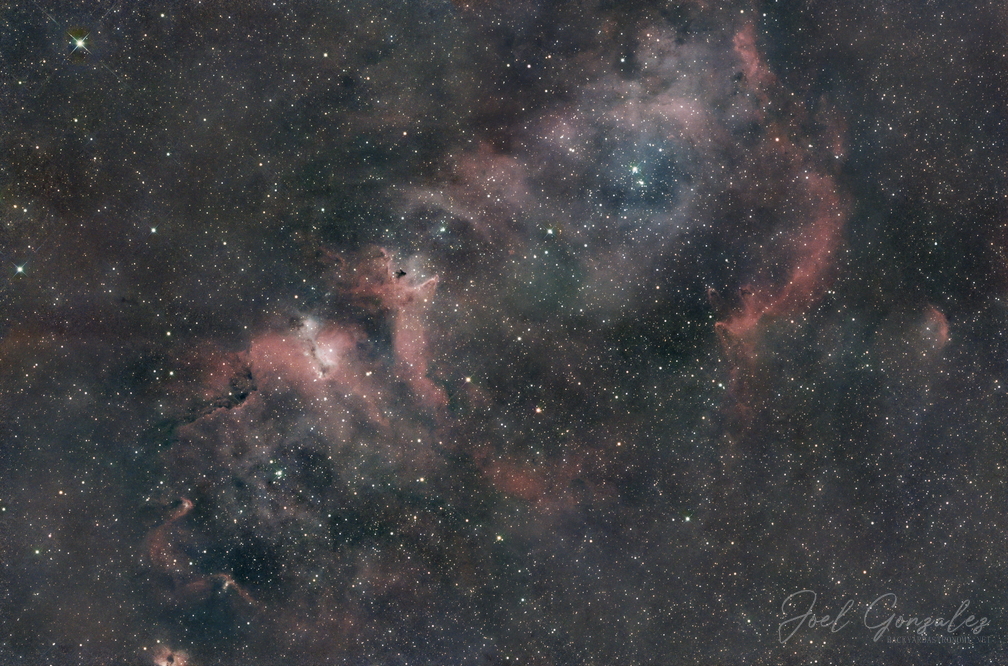
Deep in the constellation Cassiopeia lies IC 1848, the Soul Nebula, a glowing cloud of hydrogen gas shaped like a human heart. It sits right next to the more famous Heart Nebula, and together they form one of the most photographed regions of the winter sky.
The nebula shines because young, hot stars inside it blast it with ultraviolet light, knocking electrons off the hydrogen atoms. When those electrons recombine, they emit the deep red glow you see in photographs. This is the same process that powers the Orion Nebula, just on a grander scale.
Imaging the Soul Nebula from the backyard is a rewarding challenge. Because it is large and faint, you need long total integration times, often several hours spread across multiple nights. A dual bandpass filter helps by cutting out light pollution while letting the hydrogen glow through. In Siril, background extraction and careful stretching bring out the wispy details without washing out the bright core.
The Soul Nebula is about 7,500 light years away and spans roughly 100 light years across. Every photon captured in your image left that cloud of gas around the time the last ice age was ending on Earth. That is the real magic of astrophotography: your backyard telescope is a time machine.
If you have never tried a mosaic, this region is a great place to start. One frame cannot capture the full nebula at a useful image scale, so planning a two panel mosaic with the NINA framing assistant lets you cover the whole heart in stunning detail.