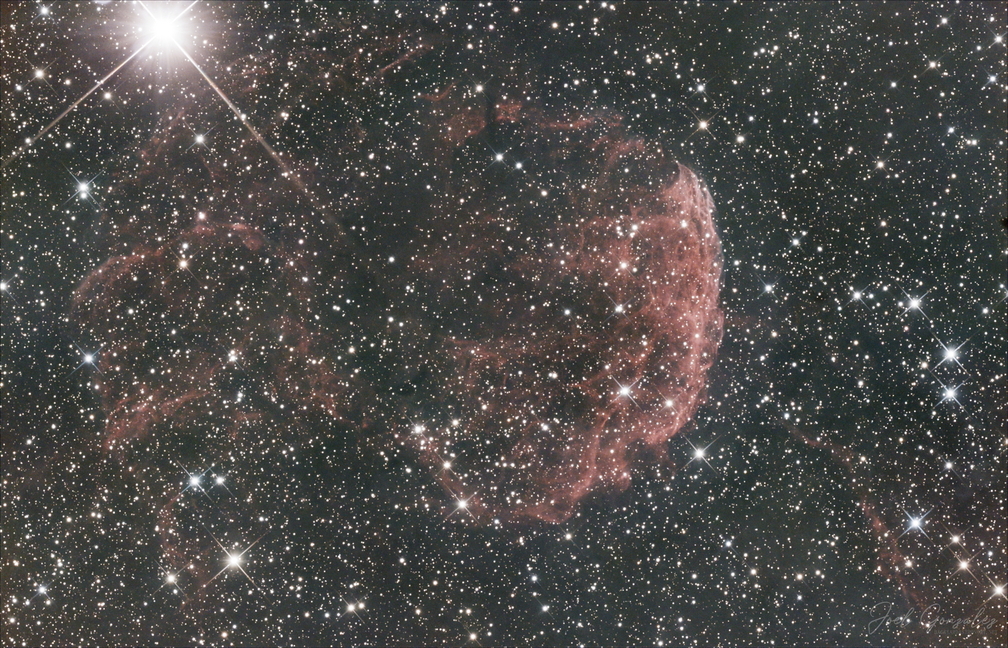

Some explosions refuse to be forgotten. IC 443, better known as the Jellyfish Nebula, is the still glowing wreckage of a star that died 30,000 to 35,000 years ago. The shockwave has been expanding ever since, and when it ran into a dense molecular cloud nearby, the debris lit up in tangled filaments that really do look like a drifting jellyfish in the sky.
IC 443 sits in Gemini, close to the star Eta Geminorum, about 5,000 light years from Earth. It is officially cataloged as a supernova remnant, Sh2-248, and it spans roughly 70 light years across. In a wide field frame it shares the stage with the open cluster M35, though this crop keeps the focus on the remnant itself.
How I Captured It
- Exposures: 58 frames of 180 seconds, about 2.9 hours total
- Telescope: Orion 8 inch 1000mm f4.9 Newtonian reflector
- Mount: Orion Atlas EQ-G
- Guide scope: Meade 800mm f10 reduced, with a Meade DSI Pro mono guide camera
- Imaging camera: Canon T3i, full spectrum modified
- Software: Framed, captured, and automated in N.I.N.A 3, stacked in Siril 1.4
Supernova remnants are a nice challenge on a modified camera. The full spectrum conversion pulls in more of the deep red emission from hydrogen and sulfur, which is exactly where these filaments live. Even with under three hours of integration, the structure came through well once background extraction and color calibration did their work in Siril.
Gemini is a great winter target because the nights are long and the remnant rides high overhead. If you want to try it yourself, plan on narrow frames and patience. The contrast between the bright filaments and the dusty region behind them rewards any extra integration time you can stack up.
The full resolution version lives in the gallery. Clear skies.